Tuesday, January 14, 2014

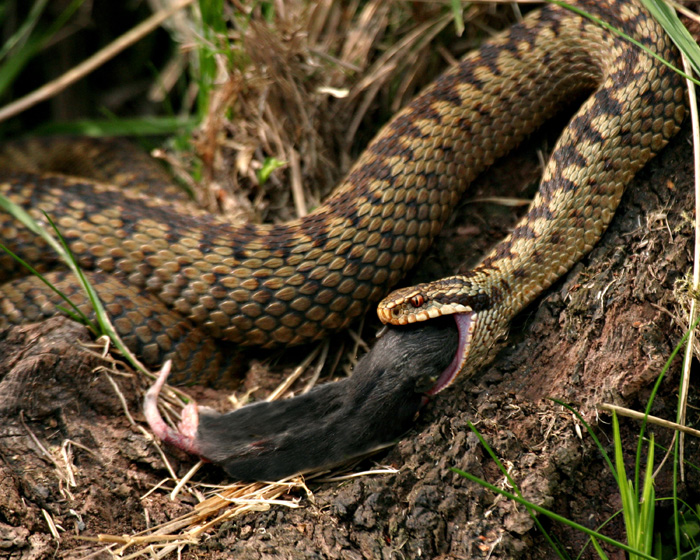
Adder Snake

A female and a male adder snake are very different and easy to tell apart- the female snake is a good 5 inches longer and has dark brown patches on her light grey scales. Other than this the snakes looks are alike- the same zig-zag pattern running down the whole body and ending in a v on the head. Like most vipers, the adder is short tailed and has a thin body. It hunts lizards, mice, and occasionally other snakes by smell.

 The adder is a northern snake- it has even been found in the Arctic Circle! It is found commonly in Europe and Siberia. It is often found living in rocks or on sunny hills. The snake hibernates whenever the temperature drops below 45 degrees. In some far north regions, the adder hibernates for 3/4 of the year. Not that this interrupts the life of the adder very much- they don't need much food to survive, and only reproduce once in every two years.

The adder is ovoviviparous- which means it lays its eggs and they hatch soon after. When the young snakes are born, they are independent, but will stick close to their mother for about a month for protection. 10-15 young are born at a time. Females grow to be about 25 inches long, while males grow to be 20 inches.


Monday, January 13, 2014

Pike

A pike is a very large and toothy fish. When I say toothy, I MEAN toothy- the pike has over 700 teeth! And for good reason, too- a pike can catch a fish as big as itself. Some pikes are so big that they can catch ducks and water rats. But pikes also have to be careful about what they eat- their mouth stretches wide and will suck in the food- but it can not reverse the motion and cough food that is too big up. Many pikes die from suffocation because they go after fish or ducks that are too big.

The true pike is found only in Europe, but in the US there are fish called northern pike. The only difference is that northern pike don't have teeth. There are also fish similar to the pike, such as the muskellunge, or as my dad calls them, "muskies". Muskellunge are VERY big, growing up to 6 feet in length. While the pike doesn't swim around very much, when it does, it can swim over 30 feet with a simple flick of it's tail. The dorsal fin is placed high on the fish's back, and the position has a lot to do with it's power when swimming.


With all the power in its swimming, the pike is an excellent stealth hunter. It camouflages in well with murky water, and when food comes swimming by- all it has to do is lunge forward and suck it in. The pike always lives in fresh water, and cannot live in water that is too deep or that is running. Pike are also known to eat their own species if food becomes scarce.

Agama

The agama is a mini-monster lizard- both in appearance AND attitude. Avid insect hunters, agamas are colored to blend into the tropical forests that are their home. They are dark green/blue, with a deep red head and a white tipped tail. This lizard is often very acrobatic and vicious when catching food, but will not be AS vicious in hot weather, as it often has to stay under shrubbery and plants if the temperature is over 100 degrees. Since the agama often preys on household pests, such as termites, it is welcomed by many people and so can safely reside in tropical towns as well as it can in the brush.

As I mentioned above, the agama has quite a nasty attitude- if anything unknowingly stumbles onto the creature's territory, it turns a fierce shade of red and charges it's opponent, and a brutal fight ensues. The agama has a powerful tail, but sometimes overestimates itself and swings its tail too hard, resulting in a broken tail. The male is also very aggressive towards other males that come near his "harem" (a group of female lizards, about 5-6 per male).

Each lizard lays about 12 eggs per mating season. The season lasts from June to September. When young are born, they are very alert and in fact copy their parents- when the females and males fight for territory, the young ones will fight amongst each other in preparation for their future. I find this funny, since human toddlers often mimic their parents and come up with the funniest things... but that is beside the point. The agama is about 1 foot long, including it's tail.

Black Salamander

The black salamander is quite a strange creature- during its mating season, forty eggs are hatched, but only two actually develop. And as if that isn't bad enough- it takes about 3 years for the young salamander to be born! It is a wonder that this species isn't extinct yet, as they are small creatures that are easily preyed upon by birds and snakes- they are only 5 inches long!

On occasion, the female will give birth to the salamander before the three years are up. She will give birth in the water to two fully developed salamanders (if the gestation period was full). The black salamander is a basic land animal and can be found in the Alps, Asia, and northern Africa. The Asian salamander is a giant variety that is 5 feet long and weighs 25 pounds- but other than that is pretty much the same as the regular sized animal.

These creatures have a toothed upper jaw, and eat insects such as millipedes, ants, termites and the like. Juveniles have a similar diet, only their diet includes flies. The black salamander is nocturnal like most lizards and hides during the day. The lizards in captivity fight, and many of the species found in the wild are scarred, leading biologists to believe that the creatures are territorial. It will bite when attacked.

Wednesday, January 8, 2014

Pigeon Hawk

Pigeon hawks are small, fearless little hunters, and are very much alike the blackbird. Pigeon hawks are found in Europe, Asia, and America. They never migrate very far: the birds from England spend their winter in North Africa, while the birds from Norway and Iceland go to England. Funny, huh?

Pigeon hawks are often found in swamps and moors, where they can hunt easily without scaring away their food. They can live happily on the outskirts of a forest, but never in one as they do not like flying at high heights, unlike most raptor birds. In fact, pigeon hawks often hunt at ground level, only chasing their food through the air if it flies. Often times they will eat small birds, but will also eat rodents and insects.

Pigeon hawks are very smart when it comes to reserving food- if they catch and kill something that is too big for them to eat, they bury it and will return to it for another meal. I think this is great, keeping in mind that the pigeon hawk is a bird and not a dog. Saving food is just one representation of how "lazy" the bird is- it doesn't build it's own nest, but instead uses the abandoned nests of other birds! If there are none nearby, it is also content with a hole in the ground with grass and twigs.

When young are hatched, the mother stays with them to protect them while the father hunts and brings back food for the babies. There are usually 4 or 5 mouths to feed. All this protection is really all for naught, however- the babies are born very independent and are often flying and fending for themselves at the age of one month.

Heron

The heron is a tall and silent fishermen. The heron has long legs, and stands in ponds and lakes motionless until a fish, frog, crab, or anything edible comes along. If it spies food, it will shoot its long neck out to spear it with its beak. This bird has a large appetite and a wide variety, meaning it will eat almost anything that comes (or swims) its way. Anything leftover (such as bones, hair, and insect casing) is regurgitated into pellets.

The only food that a heron really had 'trouble' with is the eel- the eel will wrap itself around the bird's beak and will get away. The heron NEVER fishes alone, however- it is a very social bird and nests and feeds with several other pairs of herons. The nests are built by the females high in the trees, so as to protect from predators.

 Like storks, herons use the same nest for years- but it is not always the same herons. Young herons leave the nest as soon as they can fly and often go far away from home. Herons stand about 3 feet tall fully grown (sometimes taller!) and belong to the Ardeidae family. This family has 63 species in it, all of which are scattered around the world.

Some of the more 'notable' species include the ibis, the bittern, and the egret.

BulBul

The alcoholic bird! The bulbul, a brown or green sparrow, loves ripe fruit and will eat it constantly- sometimes TOO constantly. Often, people will find these birds dead from intoxication of fruit. The bulbul gets its name from the Arab word bulbul, to describe its song. Some of the 119 species of bulbul sing so beautifully they have been mistaken for nightingales- numerous times!

I know that my Dad will sometimes talk about his "flavor savor" (his beard) jokingly. To this bird, facial hair is not a joke- the two tufts of hair on each side of their beak serve as almost flypaper, catching and slowing down insects. A few common types of bulbuls are the red-whiskered bulbul, the white-cheeked bulbul, and the black bulbul. These birds are native to South Africa. The mating of the bulbul is quite strange- the male will display the colors on his tail and the female will sing a special song. The female will then go to the nest (often low in a tree and made out of grass and vegetable debris) and lay 2-3 eggs. She will hatch these on her own.
Newborn bulbuls

The male guards the female as she sits on the nest, bringing her food and watching for enemies, like owls, crows, and mongooses. If an enemy DOES come near the nest, a bulbul will sound the alarm and the whole flock will come together and fight the predator. This goes on for 10-15 days (the incubation period of the eggs).